The Big Picture: Cigarette Keeps Smoking
Thanks to Skip Braver and his team, the world’s best-known brand of high-performance boat is still thriving.
September 11, 2009
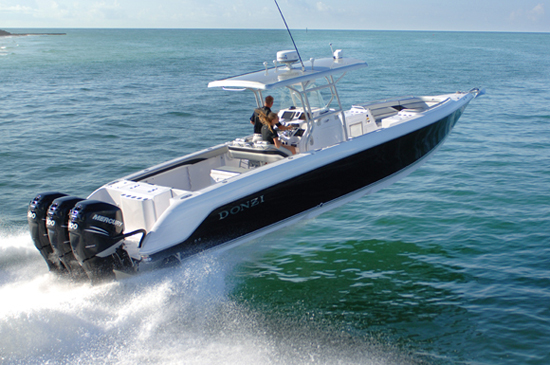
To most folks, any fast, pointy boat is “a Cigarette boat.” Trust me, I’ve written for Powerboat magazine for almost 15 years and I’ve heard it so many times that I don’t even try to correct the average Goober on the docks when he looks at a Fountain or a Formula or a Donzi or a Baja and says to his wife, “Look, honey, that’s one of them there Cigarette boats.”
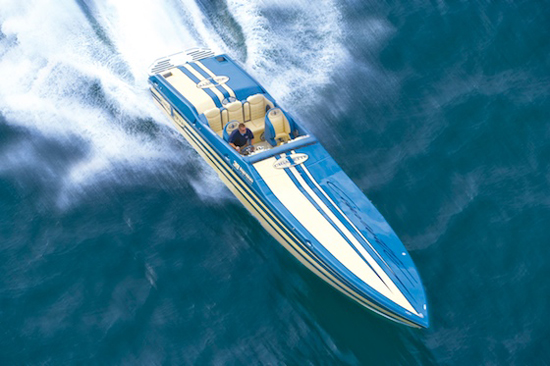
Cigarette's Top Gun remains a top seller.
I figure it’s rude to correct Goober in front of honey, unless, of course, he calls it a “Cigar boat.” Tolerant, kind and frankly wonderful as I am, that’s just too much ignorance for me to bear.
Yet just as every tissue is not a Kleenex and every flying disc is not a Frisbee (some of those discs are actually spacecraft from other planets, right Goober?), every performance-boat is not a Cigarette. But the people at Cigarette Racing are thrilled you probably think so.
“The brand recognition of Cigarette is one of the big reasons I bought the company,” says Skip Braver, the owner of Cigarette Racing Team, which is based in Opa-Locka, Fla. “It’s one of those rare, iconic brands.”
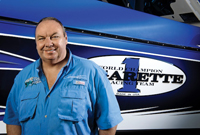
Skip Braver liked his Cigarette 42 so much he took over the company.
Cigarette was founded in 1969 by a larger-than-life entrepreneur named Don Aronow. Aronow had a flair for promotion and a keen business sense, and he marketed the brand, primarily through dominance in offshore racing, as a “real man’s” go-fast boat. Aronow wasn’t a boat designer—he knew enough to let Harry Schoell and other talented people handle that—but he was handsome and rugged and loaded with personality. And he was smart enough to know that he needed to be in his own boats on the race course.
A Cigarette boat became more than a tough V-bottom. A Cigarette boat became sexy and more than one man bought one—and many still do—in the hope that it would be the key to women’s hearts. Or at least to their bedroom doors. That perception continued after Aronow’s death in 1976—he was gunned down in a contract killing—and to some degree continues today.
But Aronow was Cigarette and Cigarette was Aronow, and after his death the company foundered. Still, it was a strong enough brand to survive years of haphazard management and shady ownership.
Braver, a former real estate developer and day trader who made his sizeable fortune in the electronics business, owned a 42-foot Cigarette and was a true believer in the brand. With long-time Cigarette production manager Neil Hernandez at his side, he acquired the company in May 2002.
“What we wanted to do right away was rebuild the integrity of the brand,” says Braver. “We wanted to build a new production facility. We wanted to improve our tool and the way the boats were built. We wanted to add new models. Through our business principles, we were able to do all of that and bring Cigarette back to where it was before. When I took Cigarette, in all honesty, there was a lot of iffy-ness flying around.”

The new Cigarette company has invested in manufacturing improvements instead of a racing team.
Braver also pulled Cigarette out of offshore racing. It was a move that the Cigarette faithful questioned and Cigarette’s competitors, at least those deeply entrenched in the sport, tried to use to their advantage. But to Braver, it was a move that had to be made and, to this day, Cigarette does not sponsor any offshore race boats.
“The Cigarette boat racing in Powerboat P1 overseas is sponsored by our Italian dealer,” says Braver. “Racing is not where Cigarette is coming from. Racing is very expensive, and we want to spend our money making our products better. That’s one reason I think we’re in a pretty good position now.”
Another reason? Braver and company introduced several new models since they took over. Two in particular—the 39 Top Gun and the 39 Top Fish—have been big sellers. Skeptics initially scoffed at the 39 Top Fish, their thinking being Cigarette was overreaching by entering the center-console fishing market.
“We’ve done very well with our fishing boat,” says Braver, when reminded of the doubters. “We’ve done very well with our 39 Top Gun. “But we’ve also done well with our 50, which is not a new model, especially in Europe.”
Despite the rough global economy, Braver says his revenues this year will likely be down by just 20 percent. To be sure, that’s a hit, but at a time when many high-performance boat companies are close to closing their doors—or have already closed them—it speaks to the power of the brand.
“In this market, being down 20 percent is pretty good,” says Braver. “We’re still building boats and we’re still taking orders for boats. We’ll have some new things at the Fort Lauderdale show in October and the Miami Show in February. We’re even getting more floor space for Miami.
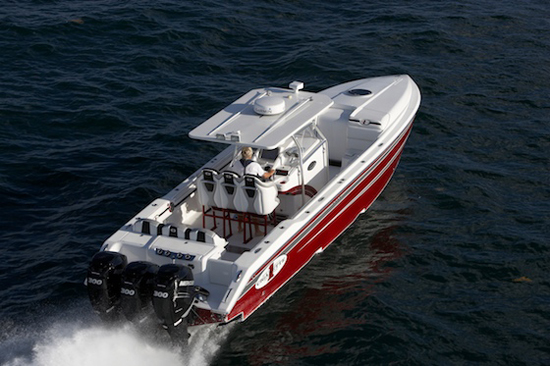
The Top Fish has broadened Cigarette's market to include sportfishing.
“In the next five years, I’d like to broaden the base of our model and take some of the new technology we’ve learned and build it into the new models,” he continues. “One thing we’ve been very good at is improving our production process. The boats are built lighter and stronger, and they look better. We continue to limit distribution with only the cream of the cream dealers. When I bought the company, we sold boats here and in France. And now we truly have become a global company—we sell Cigarette boats all over the world.”
Editor’s Note: Boats.com bi-weekly columnist Matt Trulio is the editor at large for Powerboat magazine. He was has written about boats and boating for more than 14 years.